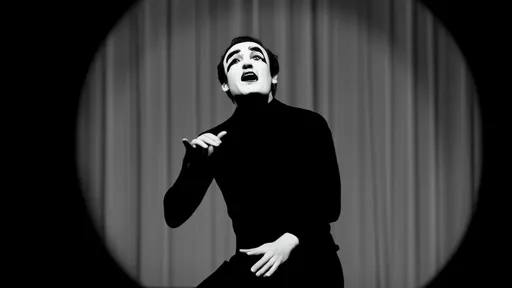
In a world increasingly dominated by digital communication and rapid-fire dialogue, the ancient art of mime stands as a silent yet profound testament to the power of unspoken expression. Mime, often misunderstood as mere street performance or children’s entertainment, is in fact a sophisticated theatrical discipline that transcends linguistic barriers. It is a dance of gestures, a symphony of movement, and above all, a poetic language of the body.
The origins of mime trace back to ancient Greece and Rome, where performers used exaggerated physicality to tell stories in open-air theaters. Unlike modern iterations, these early forms were often bawdy and comedic, designed to entertain the masses. Over centuries, the art evolved, shedding its crude edges and embracing a more nuanced approach. By the 19th century, figures like Jean-Gaspard Deburau refined mime into the elegant, white-faced pantomime we recognize today. His iconic character, Pierrot, became a symbol of silent melancholy, proving that emotion could be conveyed without a single uttered word.
What sets mime apart from other performance arts is its reliance on the body as the sole instrument of storytelling. Every tilt of the head, every flutter of the fingers, and every shift in weight carries meaning. The mime artist creates invisible walls, pulls imaginary ropes, and battles unseen forces—all with such conviction that the audience forgets these objects don’t exist. This suspension of disbelief is not magic; it is the result of meticulous physical control and an intimate understanding of human perception. The body, in the hands of a skilled mime, becomes a brush painting vivid images in the air.
Contemporary mime artists continue to push boundaries, blending traditional techniques with modern themes. Some explore social issues like isolation in the digital age, while others delve into abstract concepts such as time and memory. Companies like Théâtre de l’Ange Fou in London and the Mime Theatre Studio in Berlin have elevated the form, proving that silence can be as provocative as speech. In an era where noise is constant, the quiet intensity of mime offers a rare space for reflection.
Yet, the art form faces challenges. The rise of visual media and shortened attention spans threaten to relegate mime to the fringes of performance art. Many young artists struggle to find training opportunities, and audiences often dismiss mime as outdated or overly simplistic. But those who take the time to engage with it discover a world rich with subtlety and depth. Workshops and festivals dedicated to physical theater are slowly reviving interest, reminding us that the human body remains the most universal medium of expression.
To witness a master mime at work is to see poetry in motion. There is no script, no soundtrack, no elaborate set—just a body speaking volumes in perfect silence. In a single gesture, a mime can convey joy, sorrow, or existential dread. This is the essence of the art: not the absence of sound, but the presence of something far more primal and immediate. As we navigate an increasingly noisy world, perhaps the quiet eloquence of mime has never been more necessary.
By /Jul 9, 2025

By /Jul 9, 2025
By /Jul 9, 2025
By /Jul 8, 2025

By /Jul 8, 2025
By /Jul 8, 2025

By /Jul 8, 2025

By /Jul 8, 2025
By /Jul 8, 2025
By /Jul 8, 2025
By /Jul 8, 2025
By /Jul 8, 2025
By /Jul 8, 2025

By /Jul 8, 2025
By /Jul 8, 2025
By /Jul 8, 2025
By /Jul 8, 2025

By /Jul 8, 2025