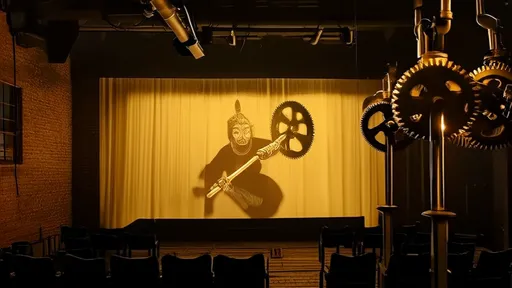
The ancient art of shadow puppetry, a cultural treasure with roots stretching back over two millennia, is undergoing a radical transformation. In workshops and studios across China, engineers and artists are collaborating to replace human fingers with precision-engineered mechanical systems. This fusion of tradition and technology is giving birth to what enthusiasts are calling "intelligent shadow play" – a new form of performance that maintains the aesthetic charm of the original while introducing unprecedented consistency and complexity in movement.
Traditional shadow puppetry requires years of training to master. Performers manipulate flat leather puppets against a backlit screen, using up to five rods per puppet to create the illusion of movement. The slightest tremor in a puppeteer's hand becomes magnified in the performance. Now, servo motors and programmable controllers are assuming this role, executing movements with robotic precision that no human hand could match. The mechanical arms never tire, never shake, and can repeat sequences with identical timing down to the millisecond.
Behind this technological revolution stands a team of engineers from Xi'an University of Technology who have spent nearly a decade perfecting their mechanical puppeteers. Their latest system can control up to twelve puppets simultaneously, each capable of movements so rapid and precise they create effects impossible in traditional performances. "We're not replacing the artist," explains Dr. Liang Wei, the project's lead engineer, "we're giving them a new kind of brush to paint with. The programming still requires an artistic touch – someone must teach the machines how to move with grace and emotion."
The transition hasn't been without controversy. Traditionalists argue that the imperfections of human manipulation give shadow puppetry its soul. They point to subtle variations in timing and pressure that convey emotion – the slight hesitation before a dramatic movement or the barely perceptible tremble during an emotional scene. Mechanical systems, they claim, risk making performances feel sterile. In response, the technologists have developed algorithms that introduce controlled variability, mimicking the natural inconsistencies of human performance while maintaining overall precision.
Performances using the new technology have drawn mixed reactions. At a recent demonstration in Beijing's Liyuan Theater, the audience marveled at battle scenes featuring dozens of perfectly synchronized soldiers, their sword strokes identical yet somehow individual. But some veteran puppeteers noted the absence of what they called "the breath between movements" – those micro-pauses where anticipation builds. The development team has taken such feedback seriously, working with veteran performers to capture and digitize these almost imperceptible elements of timing that separate good performances from great ones.
Beyond preservation, the technology opens new creative possibilities. Mechanical systems can execute movements at speeds impossible for humans, allowing for dazzling displays of agility. They enable precise coordination between multiple puppets, making possible complex scenes that would require an impractical number of human operators. Some experimental performances have incorporated projection mapping and digital effects, blending the physical puppets with virtual elements in ways that expand the visual language of the art form while remaining true to its essence.
The economic implications are significant. Traditional shadow puppetry troupes often struggle with the costs of training and maintaining skilled performers. Mechanical systems require substantial upfront investment but promise long-term savings and more consistent performance quality. This could make commercial viability more attainable for troupes operating outside government-supported cultural preservation programs. Already, several theme parks and cultural tourism sites have expressed interest in installing permanent mechanical shadow play theaters that can operate continuously without performer fatigue.
As the technology matures, questions about authenticity and cultural preservation loom large. UNESCO, which recognized Chinese shadow puppetry as Intangible Cultural Heritage in 2011, has begun discussions about how to categorize these mechanized performances. While some argue they represent an evolution of the art form, others worry they might eventually displace traditional methods. In response, many troupes are adopting a hybrid approach – using mechanical systems for certain elements while keeping human performers for others, creating performances that showcase both technological innovation and traditional craftsmanship.
Looking ahead, the integration of artificial intelligence promises to take mechanical shadow play into even more revolutionary territory. Experimental systems are beginning to incorporate machine learning algorithms that can analyze traditional performances and generate new movement patterns in appropriate styles. This raises fascinating questions about the nature of artistic tradition in the digital age. Can a machine learn the cultural context and emotional depth behind centuries-old performance techniques? The answer may determine whether intelligent shadow play becomes merely a technical curiosity or a legitimate new chapter in this ancient art form's history.
The story of mechanical shadow puppetry mirrors broader tensions between tradition and innovation in Chinese cultural preservation. As the technology spreads from experimental workshops to mainstream performance spaces, it challenges fundamental assumptions about how traditional arts should evolve in the modern world. What remains unquestioned is the enduring power of the shadow play form itself – whether manipulated by human hands or mechanical arms, the magic of light and shadow continues to captivate audiences just as it did two thousand years ago.

By /Jul 9, 2025

By /Jul 9, 2025

By /Jul 9, 2025
By /Jul 8, 2025

By /Jul 8, 2025

By /Jul 8, 2025

By /Jul 8, 2025

By /Jul 8, 2025
By /Jul 8, 2025
By /Jul 8, 2025

By /Jul 8, 2025
By /Jul 8, 2025
By /Jul 8, 2025

By /Jul 8, 2025
By /Jul 8, 2025

By /Jul 8, 2025

By /Jul 8, 2025
By /Jul 8, 2025